
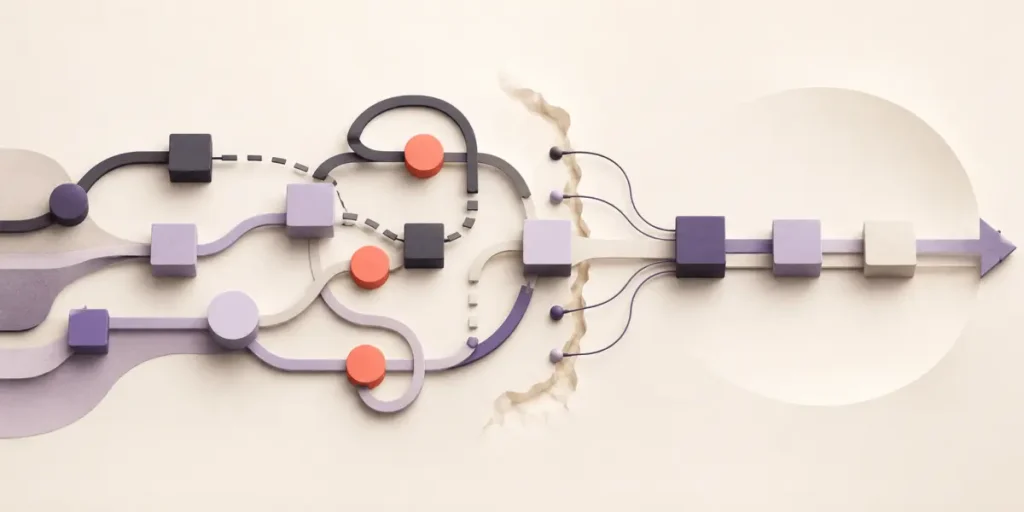
If your projects keep stalling, it rarely feels like a single clear problem. From the outside, everything looks active. People are working, meetings are happening, updates are being shared. But underneath that activity, something is off. Progress is slower than expected. Deadlines keep slipping. You find yourself revisiting the same conversations again and again.
I’ve seen this pattern across iGaming product launches, regulatory compliance programmes, digital transformations, and more recently data and AI implementations. Different industries, different teams, same underlying issue. Work is happening, but it’s not quite landing.
At some point, you stop asking “what are we doing?” and start asking “why is this not moving?”
Where do projects start to stall?
Most people assume projects stall because something goes wrong. A bad decision, a missed deadline, a weak team. In reality, it’s usually more gradual than that. The project starts with a clear intention. There’s energy, alignment, and momentum. Then the work begins, and complexity starts to build. More people get involved. Dependencies appear. Priorities shift. New information comes in.
Nothing breaks immediately. But things become slightly harder to coordinate. I worked on a regulatory programme where the deadline was fixed and non-negotiable. Everyone understood the importance. The team was experienced and capable. But the work cut across multiple functions, each with their own priorities and constraints.
At first, progress was steady. Then delays started to appear in small ways. A dependency here, a decision there. No single issue was critical, but together they slowed everything down. That’s how most projects stall. Not with a bang, but with friction.
The real causes are usually hidden in plain sight
When projects start slipping, people often focus on visible symptoms. Missed deadlines, supplier delays, teams not delivering as expected. But those are usually signals, not causes. In my experience, stalled projects tend to share a few underlying patterns.
Clarity is often weaker than it appears. Everyone agrees on the general objective, but if you ask three people what “done” looks like, you get three slightly different answers. That alone is enough to create rework and hesitation. Plans exist, but they don’t reflect reality. They assume stable priorities, available resources, and smooth dependencies. Real projects rarely behave that way.
Ownership is spread, but not anchored. Work is shared across teams, but no one is actively holding the whole. Decisions take longer because the impact isn’t fully visible. Dependencies are underestimated. Whether it’s suppliers, internal approvals, or system integrations, projects rely on things outside direct control. When those dependencies are not actively managed, delays ripple through the work. None of these issues are dramatic on their own. Together, they slow everything down.
Working harder won’t fix it
When a project stalls, the natural reaction is to push harder. More meetings. More updates. More effort. I’ve seen teams do this in Agile environments, in Waterfall programmes, in Scrum setups, in Kanban flows. The approach changes, but the instinct is the same. The problem is that more activity doesn’t solve structural issues. If clarity is missing, more updates just repeat the same ambiguity. If ownership is unclear, more meetings don’t create accountability. If the plan doesn’t reflect reality, working harder against it only increases frustration. This is why stalled projects often feel exhausting. A lot of energy is being spent, but not always in the right place.
How to get projects move again
The shift usually starts with stepping back, not pushing forward. You need to see the project as it really is, not as it was originally planned. That means getting clear on what is actually being delivered and what “done” really means. Not in abstract terms, but in a way that everyone involved would describe it the same way. It means looking honestly at the current state of the work. What is genuinely complete, what is in progress, and what is at risk. Not what should be happening, but what is happening. It also means making ownership explicit. Someone needs to be responsible for holding the whole picture. Not just individual tasks, but how everything connects.
Dependencies need to be visible and actively managed. This is especially important in projects involving suppliers or cross-team work. If you don’t track what you depend on, you will always be reacting to delays rather than anticipating them. In a data and AI implementation I worked on, the turning point came when we stopped trying to push the original plan forward and instead rebuilt the delivery view based on what was actually true. Within a few weeks, progress became more predictable, simply because the plan matched reality.
The role of experience
Frameworks help, but they don’t solve this on their own. I’ve used PMP principles in structured programmes, Agile and Scrum in product environments, and Kanban in continuous delivery setups. They all provide useful tools, but they don’t replace judgement. Knowing where to focus, what to simplify, and what to challenge comes from experience.
It’s recognising that a “small delay” is actually a sign of a bigger dependency issue. It’s seeing when a team is overloaded even if they’re not saying it directly. It’s understanding when a plan is no longer credible. That’s often where external or fractional project support helps. Not because the team can’t do the work, but because someone needs to step outside the day-to-day and reconnect the moving parts.
A simple way to test your project
Ask yourself this directly. If you left this project alone for two weeks, would it continue to move forward in a meaningful way? If the answer is no, the project is being held together by effort rather than structure. That’s usually the point where things start to stall.
If your projects keep stalling, it doesn’t mean the idea is wrong or the team is weak. It usually means the structure hasn’t kept up with the complexity. Once you address that, things tend to move again. Not instantly, but steadily. With more clarity, better alignment, and fewer surprises.
That’s what gets projects back on track. Not more pressure, but better connection between what you’re trying to do and how you’re actually doing it.